
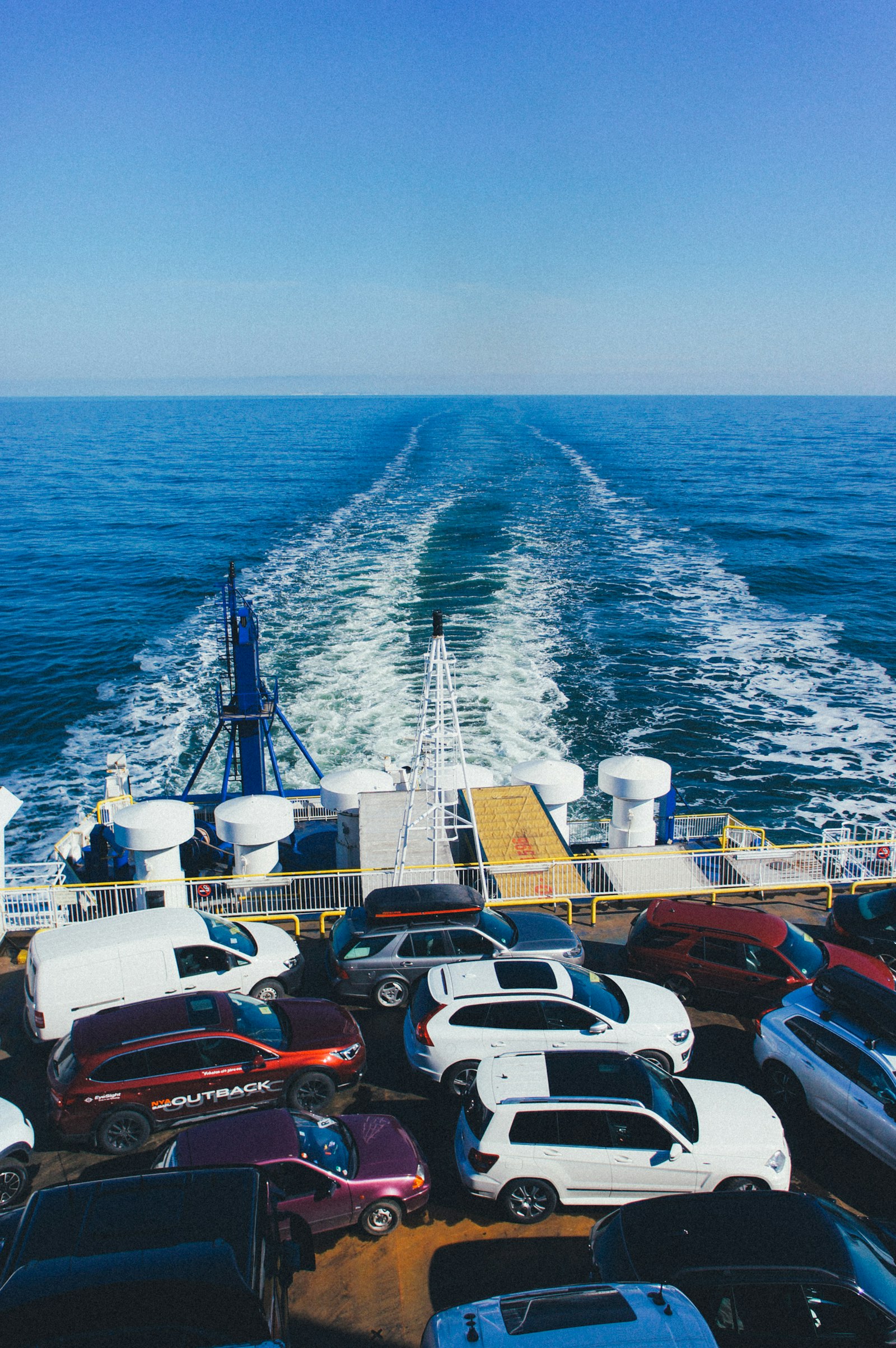
How to Choose a Vehicle Ferry Booking System
A vehicle ferry is not a passenger boat with cars on it. The deck is a physical structure with measurable constraints — lane metres of usable length, tonnage rated per deck, overhead clearance under cover, dangerous-goods rules governing where certain loads can travel, charging-equipped bays some routes track separately, and trailers and caravans linked to a towing vehicle but consuming their own space. Most general booking platforms treat that complexity as "spaces" and a few vehicle classes. That works until the 12-metre tipper rolls up booked as "one truck", or the 3.5-metre removalist van shows up at the under-cover queue with a 2.1-metre clearance, or the car-with-caravan arrives on a ticket that covered the car only.
This guide is for vehicle ferry operators evaluating their booking platform — operators running one or more RoRo or RoPax vessels with vehicle decks, mixed passenger and freight, taking some combination of advance bookings, walk-up at the wharf, and freight through an agent portal, and increasingly thinking about whether the ferry should sell alongside the destination tour, the overnight stay, or the return-transport leg as one bookable thing.
The article is vendor-agnostic — what to look for, what to ask, what good answers sound like, what red flags to watch for. There's one short section near the end on where JetSetGo fits. The rest is the framework, not the pitch. If you also operate passenger-only sailings, the companion piece How to Choose a Ferry Booking System covers the general ferry side; this one stays on the vehicle deck.
Why "how to choose" matters more here than for most segments
Vehicle ferry software has fewer credible vendors than almost any other transport or tourism category. Most general booking platforms can sell a ticket and print a manifest — few can model the deck. The platforms that do cluster into two shapes: vehicle-ferry-specialist tools that handle the deck well but stop at the ferry, and broader transport platforms with serious vehicle-deck capability alongside passenger inventory, packaged product, and channel rules. Both shapes work; the question is which one fits your operation now and three years from now.
The cost of a bad choice shows up at peak season. A platform that confirms bookings the deck can't physically honour, can't model the under-cover clearance, or treats a car-with-caravan as one entity generates queue-side problems the wharf team resolves by hand for the rest of the season. The cost of a slow choice is the year you spend running the old platform alongside the new one because migrating in summer isn't an option.
What a vehicle ferry booking platform actually has to do
Seven capabilities matter more than the rest — the ones a serious vehicle deck operation lives or dies on.
Multi-dimensional inventory, not a flat space count. A vehicle deck's capacity is not "30 cars and 2 trucks". It is lane metres of usable length, tonnage spread across decks rated for different loads, overhead clearance under cover versus open, hazmat acceptance per deck, EV-equipped bays some routes track separately, and vehicle-class restrictions ("motorbikes never on the open-truck deck") enforced structurally. Each dimension should run as an independent constraint, checked simultaneously at booking time. A platform that holds capacity as a single number works for a small launch; it does not work for a RoRo with three decks and seven vehicle classes. The vehicle ferry inventory capability doc describes how the deck should be modelled.
A vehicle catalogue with real dimensions, not customer guesses. A 4.5-metre car consumes 4.5 lane metres; a 6.2-metre motorhome consumes 6.2. Asking customers to measure their car is not a serious answer — operators using that approach reconcile reality at the wharf. The platform should carry a catalogue of makes, models, years, and body types with length, width, height, weight, and an EV flag, so the booking flow looks up the right dimensions automatically. Trucks, buses, and custom builds outside the catalogue go into a per-operator list. Attachments — bullbars, roof racks, kayaks past the bonnet — should extend the parent's dimensions rather than getting waved through. (More on lane metres, tonnage, and height as independent constraints →)
Refusal at the inventory layer, not at the wharf. When a vehicle physically cannot fit — under-cover clearance won't take the van, the deck is at its tonnage rating, no deck accepts the declared hazmat class — the platform should refuse the booking at the website, not at the kiosk at 06:00 with a queue forming. Refusing at the inventory layer is what makes the manifest honest. Every confirmed booking is one the deck can carry.
Walk-up at the wharf as a core capability, not an afterthought. Most vehicle ferry operations take some walk-up traffic; many take a great deal. The kiosk has to handle card payments without slowing the queue, recognise concession cards at the till (resident, pensioner, trade-account), scan QR tickets with cryptographic validation, and work offline when the wharf's mobile signal drops. The walk-up sale has to land on the live manifest the moment the card clears and decrement the website's available-spaces count in the same second. Walk-up and advance booking should draw from one shared inventory pool, not parallel "kiosk reservation" and "online reservation" blocks the office reconciles after the fact. The check-in and boarding capability doc covers the mechanics.
A pricing engine that meters what the deck actually consumes. Flat per-vehicle rates work for short-route community ferries. Beyond that, the engine should run consumption-based pricing — a truck billed by lane metres, a cabin priced per berth and per night on RoPax overnight runs, freight priced by tonnage, per-sector pricing on multi-stop routes — alongside versioned price lists with peak / off-peak / shoulder tiers, channel-specific tiers, and a visual rule builder for resident concessions, hazmat surcharges, early-bird discounts, and trade-account rates. One sailing should run flat passenger pricing, consumption-based vehicle pricing, and peak tiers across both. The pricing engine capability doc covers the depth.
Channel rules that work in the operator's favour. Most vehicle ferries above a certain size run at least three of direct website, walk-up kiosk, agent portal, OTA connectors for foot passengers on RoPax, B2B trade accounts. The platform should let the operator cap how much of every sailing OTAs can sell, reserve under-cover deck for direct bookings, hold a freight allocation for trade-account customers, and release reserved capacity a configurable window before departure if unsold. The platform's business model should sit on the operator's side — pure-SaaS platforms charge a fee and don't compete for the end customer; marketplace-model platforms carry an inventory-aggregation incentive that can pull in a different direction. The channel management capability doc covers the mechanics.
Operational and audit tooling for the wharf, the wheelhouse, and the contract manager. The deck supervisor needs a live manifest on a tablet, filterable by vehicle reference, with cryptographic QR validation and manual ticket-reference entry when a QR is damaged. Operators on a council or government route contract face probity-grade audit requirements — every ticket, payment, modification, refund, concession-card lookup, and boarding scan attributed to vessel, skipper, and payment trail, in the format the contracting body asks for. Audit attributes have to be captured as structured events, not free-text fields. (Designing a ferry audit trail that holds up to outside review →)
The make-or-break moments most platforms fail at
Beyond the foundation sit a handful of specific operator scenarios that look small in a demo and turn out to be where most vehicle ferry platforms quietly break.
Towed vehicles and trailers as linked entities, not "the car plus a notes field". A car towing a caravan is not one entity with a longer length. It is two entities the platform should know belong together — booked on one transaction, sailing together, allocated adjacent slots — but recorded separately for reporting, accounting, and the restrictions that apply specifically to the combination. The towed unit has its own dimensions, its own hazmat declaration if it carries dangerous goods independently, and rules that don't apply to either entity alone: limited manoeuvrability ruling combinations out of tight bow-loading lanes, length-plus-trailer caps on certain decks (a 12-metre truck with a 6-metre trailer doesn't fit even where lane metres remain, because the deck's turning circle or ramp angle can't accept the combined length), stern-loading-only decks where reversing a caravan onto an upper deck isn't a manoeuvre the deck supervisor will sign off. A B-double truck with two trailers is three linked entities. Ask any vendor how their model holds the towing relationship — "we have a checkbox for trailer" is the wrong answer.
EV-spaces as independent inventory. Charging-equipped berths are scarce on most routes that have them; deck-side EV restrictions and insurance constraints around lithium-battery loads are becoming more common as EV share of the fleet rises. Some operators require EV batteries no higher than 40% charge for the crossing; some restrict the number of EVs per deck on lithium-fire-risk grounds; some capture EV registration data at booking for insurance reporting. (Marine insurers have published recommendations on the safe carriage of electric vehicles on RoRo and RoPax vessels.) The platform has to model EV-spaces as a separate capacity unit from regular car spaces — an EV car consumes one car space (in lane metres) AND one EV space — without forcing the operator to invent a hybrid vehicle class. When EV bays are full, further EV bookings should be refused even if regular car space remains.
Dangerous-goods handling at booking and at the wharf. Hazmat is where vehicle ferries are most heavily regulated and where most general booking platforms have nothing to offer. IMDG-class restrictions apply per vessel and per deck — RoPax ferries carrying more than 25 passengers face stricter rules on what can be carried under deck, with some classes permitted only on the weather deck or not at all on certain hull configurations. (IMDG Code chapter 7 sets the stowage categories.) The booking flow should ask the right declaration question for vehicles where it applies — freight, tradesman vehicles, fuel trucks, larger commercial loads — and the deck allocator should respect the class restriction structurally. A class-3 flammable gets allocated only to a deck flagged to accept class 3; restricted-quantity exceptions for the tradesman's gas cylinders should resolve to "allowed" without operator intervention. (Hazmat on vehicle ferries — the practical guide →)
Refusal that explains the right thing to the customer. When a booking is refused, the reason matters. A 3.5-metre van refused from the under-cover deck on height should be re-allocated to the open deck and the customer informed. A heavy truck refused at the tonnage limit should be offered the next deck that can carry the load. A hazmat-class load refused because no deck on the vessel accepts the class should fail before the customer pays. Most platforms that model the deck as a flat seat count return "sold out" or "error" when any of these fire, and the reservations team gets the angry phone call. A platform that walks the decks in priority order and explains the refusal turns a queue-side problem into a website-side one.
The ferry as one leg in a wider trip, sold as one bookable thing. Vehicle ferry bookings increasingly include the destination tour, the overnight stay, the return ferry, or the vehicle-included transfer to inland accommodation. On most ferry-specialist platforms that is four separate transactions across two or three systems — and a six-month integration project the next time the operator's product mix shifts. The platform should bundle the products into one booking — operator picks the anchor leg (the customer selects the ferry first), platform checks availability across every leg and confirms only if every leg is bookable. The deeper segment overview lives in the multi-modal booking platform pillar; the alternative is running the ferry on one platform and the rest of the operation on another, with the operator's team as the integration layer.
Where most evaluations go wrong
The most common mistake is treating the demo's smooth path as evidence the platform handles the broken paths. The smooth path is one car, one driver, one sailing — every platform handles that. The broken paths — the 6.2-metre motorhome booked as "one car", the car-with-caravan-and-bike-rack arriving larger than the booking declared, the hazmat freight load on a sailing the platform thinks can carry it but the maritime authority says cannot — are where vehicle ferry software is actually tested. Ask the vendor to walk a broken path on screen.
The second is over-weighting the front-end booking flow at the expense of operational tooling. Operators spend many more staff hours in the manifest, the kiosk, the audit report, and the disruption-handling flow than customers spend at the checkout. A platform that confirms bookings the deck can't honour is worse — every overbooking is a customer who paid and arrived, and a wharf team picking up the bill.
The third is evaluating against today's operation rather than the one you're heading toward. A platform that can't model the deck properly, can't bundle the ferry into a wider package, and can't run per-channel rules is one you'll outgrow in three years. Better to pay for the modelling depth now — even if half of it sits switched off — than to switch twice.
A 10-question framework you can put to every vendor
Print this. Run every vendor against it. Score each answer 1–5 against your operation and total it up.
Vehicle deck modelling depth. Draw our largest vessel as your platform's model holds it. How are lane metres, tonnage, height, hazmat class, EV-spaces, and vehicle-class restrictions enforced? What happens when a booking violates more than one constraint at once?
Vehicle catalogue and dimensions. Do you carry a catalogue of makes / models / years with real dimensions, or do you ask customers to measure their car? How are trucks, buses, and custom builds outside the catalogue handled? How do attachments extend the parent vehicle's footprint?
Towed vehicles and trailers. Walk us through a car towing a caravan, a truck with two trailers, and a car towing a boat trailer. How does the platform know they're linked? How are length-with-trailer caps, manoeuvrability rules, and trailer-specific hazmat declarations enforced?
EV-spaces and electric vehicles. Show us how EV bays are tracked separately from regular car spaces, how an EV car consumes both, and how EV-specific restrictions (charge-level caps, per-deck EV limits, registration-data capture) are configured.
Dangerous goods at booking and at the wharf. Walk us through a class-3 flammable on a passenger-carrying RoPax. How does the booking flow capture the declaration? Which decks accept which classes? How are restricted-quantity exceptions resolved?
Refusal that explains the right thing. A 3.5-metre van books against the under-cover deck. A heavy truck books against a deck at its tonnage limit. A class-1 explosive books against a passenger-carrying RoPax. What does the customer see in each case?
Walk-up at the wharf. Show us the kiosk POS in offline mode. How does the till recognise a verified resident or trade-account card? Does the walk-up sale decrement the website's available-spaces count in the same second?
Pricing breadth. Can you price one vehicle category flat, another by lane metre, and a third by lane metre plus tonnage on the same sailing? Per-sector fares alongside peak / off-peak tiers that switch automatically by date? Can a hazmat surcharge, a resident concession, and a channel-specific tier all apply to one booking?
Channel rules. Show us how we cap OTA share at 40%, reserve 10% of the under-cover deck for direct bookings released 24 hours out, and hold a freight allocation for trade-account customers across every sailing.
Multi-product and growth. If we add accommodation, a destination tour, or a transfer coach next year, what does that look like? Can the ferry and the destination product sell as one bookable thing with shared availability checks across every leg?
What the answers should sound like
A confident answer is specific. A vague answer is a warning.
On deck modelling, the vendor draws your largest vessel live on screen and runs a booking through a violating combination so you can watch the platform refuse it with the right explanation. On towed vehicles, the vendor walks a car-and-caravan booking, the deck allocation, and the reporting that breaks out caravan movements from car movements. On hazmat, the vendor shows the per-deck class table and walks a class-3 flammable through the allocator. On channel rules, the rule editor appears live with example configurations.
Red flags: "we'll build that for you"; "that's on the roadmap"; "it's just a configuration change" without the configuration shown live; vague answers on hazmat or EV handling (this is where the deep work lives — vague means shallow); reference customers the vendor declines to name. A reference call with a vehicle ferry operator at roughly your scale, on a route configuration similar to yours, is the single most useful input you'll get.
Where JetSetGo fits in your shortlist
JetSetGo is one of the platforms worth putting through the framework above. The capabilities map directly: a hierarchical vehicle-deck inventory model with lane metres, tonnage per weight-rated deck, height per under-cover area, hazmat acceptance per deck, EV-spaces tracked independently, and towed vehicles as linked entities the platform knows belong together but reports on separately; refusal at the inventory layer rather than at the wharf; a vehicle catalogue with real dimensions; walk-up POS with offline mode and cryptographic QR validation; channel rules with limits, reserves, and release timing; a pricing engine that runs flat, consumption-based, per-sector, per-night, peak-tier, and visual-rules logic in any combination; multiple cancellation policies per product through product variations (cancellation policies capability doc); audit-grade reporting backed by a BI layer; and a package builder that ties the ferry crossing to a destination tour, an accommodation night, or a return-transport leg as one bookable thing.
If your evaluation surfaces multi-dimensional inventory, towed-vehicle linkage, EV-space tracking, hazmat handling, channel control, or multi-product packaging as load-bearing requirements, JetSetGo is worth shortlisting. The dedicated comparison page is JetSetGo vs FerryHawk.
Where to go next
The deepest segment overview is the vehicle ferry software pillar. For the broader ferry context — passenger inventory, council-route reporting, mixed walk-up and advance booking — the ferry booking system pillar. The capability docs on vehicle ferry inventory, channel management, check-in and boarding, and pricing engine are the mechanics. For operator-side dives — activity-booking platforms versus vehicle decks, council ferry audit reporting, vehicle ferry capacity, and dangerous goods on vehicle ferries.
When you're ready to put a vendor through the framework, book a demo.